Entries Tagged as 'Learn to write good'
March 6th, 2006 · Comments Off on “She shrugged with her buttocks”
How did anyone learn to write before “Thog’s Masterclass“?
This month’s collection of (published) bad examples just arrived in Dave Langford’s latest issue of Ansible.
Wouldn’t you like a few blasts from Thog’s horrible past?
- `Wearing an aura of rugged-intellectual charm like a plastic raincoat …’ — Sam Merwin Jr, The Time Shifters
- `Gosseyn’s intestinal fortitude strove to climb into his throat, and settled into position again only reluctantly …’ — A.E.van Vogt, The World of Null-A
- `The wagon lurched forward like an armadillo trying to mate with a very fast duck.’ — James P Silke, Frank Frazetta’s Death Dealer, Vol II Lords of Destruction
Thank you, David Langford, and thank you, Thog!
Tags: Learn to write good
December 3rd, 2005 · Comments Off on Jane Austen heroines meet heroin chic?
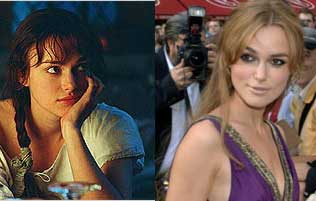
Director Joe Wright’s new Pride and Prejudice boils Jane Austen’s novel down to romcom period romp. Overcoming my prejudice, I enjoyed the movie–though I would have enjoyed it more if its lovely high-spirited ingenue and her standard-issue tortured, brooding swain hadn’t been called “Miss Elizabeth Bennet” and “Mr. Darcy.”
And would somebody please get poor “Mr. Wickham” out of that Legolas wig and into McDonalds? Feed him some cheeseburgers, I think he’s starving to death…
Tags: Learn to write good
July 2nd, 2005 · Comments Off on Is that right? Or, philosophy versus religion…
“Philosophy is the study of questions that can’t be answered,
Religion is the study of answers that can’t be questioned,
and Criminal Justice is about right and wrong.”
Tags: Learn to write good
June 17th, 2005 · Comments Off on What is it about Morris dancing and Terry Pratchett?
We live in a mysterious universe, and springtime is a mysterious process in said universe–which the existence of Morris dancers only makes much more so…
The Morris dance is common to all inhabited worlds in the multiverse.
It is danced under blue skies to celebrate the quickening of the soil and under bare stars because it’s springtime and with any luck the carbon dioxide will unfreeze again. The imperative is felt by deep-sea beings who have never seen the sun and urban humans whose only connection with the cycles of nature is that their Volvo once ran over a sheep…
Just one of many Terry Pratchett quotes about Morris Dancing…
Tags: Learn to write good
May 1st, 2005 · Comments Off on Wow, two different words for “fear of France”…
…not to mention concise ways to describe such concepts as “fear of beards” (pogonophobia), “fear of prolonged waiting” (macrophobia), and “fear of peanut butter sticking to the roof of your mouth” (arachibutyrophobia).
Want more? I’m afraid I can’t list them all (“myxostrophilophobia” — and, yes, I did just invent that one), but here are a few:
Aboulomania: pathological indecisiveness.
Cacodemomania: pathological belief that one is inhabited by an evil spirit.
Catapedamania: obsession with jumping from high places.
Ecdemomania: abnormal compulsion for wandering.
Eleutheromania: manic desire for freedom.
Enosimania: pathological belief that one has sinned.
Habromania: insanity featuring cheerful delusions.
Lypemania: extreme pathological mournfulness.
Metromania: insatiable desire for writing verse.
Opsomania: abnormal love for one kind of food.
Pteridomania: passion for ferns.
From the morning Internet wanderings of Frank Wilczek and The Phrontistery, though Frank says he found the first reference in the New York Times somewhere…
Tags: Learn to write good
March 28th, 2005 · Comments Off on Gandalf, Emma, and (in a post script) Eeyore
Character test: can you stop reading halfway through this list?
It’s a collection of favorite literary characters* as chosen by “100 literary luminaries” (one of whom is Terry Pratchett, who liked Flashman).
Abandon restraint and dive into the list (Anne Elliott … Phillip Marlowe … the Cat in the Hat …) , enjoying the tiny blurb that goes with each choice and being reminded of your own special favorites.
Bonus list: an even-more enjoyable collection of
favorite characters sent in by indignant readers. Bonus surprise: the name of a blog superstar, who turns out to share said name with a Graham Greene policeman.
* Via Jason Kottke’s linkblog.
Tags: Learn to write good
February 12th, 2005 · Comments Off on White valentine
| The February 14 New Yorker includes a short memoir of E.B. White by his stepson Roger Angell.
Angell gives special attention to two of my favorite essays, “Once More to the Lake” and “This is New York”–which, coincidentally, I blogged here exactly two years ago, struggling to understand what makes White so funny.)
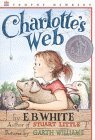
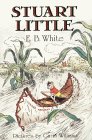
Angell offers delightful backstage details about White’s Charlotte’s Web and Stuart LIttle. He also includes somewhat Too Much Information about White’s illnesses, fretfulness, and fear of crowds. Well, it’s a sad fact of the way lifespans overlap that the our parents’ old age and frailty can fill so much foreground of our adult memories.
Of course the best bits are the bits that are written by White–a letter about baby birds, or this fragment from an essay on driving Maine highways:
Like highways everywhere it is a mixed dish: Gulf and Shell, bay and gull, neon and sunset, cold comfort and warm, the fussy façade of a motor court right next door to the pure geometry of an early-nineteenth-century clapboard house with barn attached. You can certainly learn to spell moccasin while driving into Maine, and there is often little else to do except steer and avoid death. Woods and fields occur everywhere, creeping to within a few feet of the neon and the court, and the experienced traveler into this land is always conscious that just behind the garish roadside stand, in its thicket of birch and spruce, stands the well-proportioned deer; just beyond the overnight cabin, in the pasture of granite and juniper, trots the perfectly designed fox. . . .
The Maine man does not have to penetrate in depth to be excited by his coastal run; its flavor steals into his consciousness with the first ragged glimpse of properly textured woodland, the first whiff of punctually drained cove.
Anyway, do yourself and your Valentine a favor–read this loving essay and pass it on.
|
|
Tags: Learn to write good
November 14th, 2004 · Comments Off on “All you need is #384″
WordCount* is an
online toy based on word popularity. (It ranks common English words
from #1 –“the”– to #86,800–“conquistador”.) You can use it to:
* Embellish short quotes or poems by giving each word its own popularity number:
“All (#41) you (#14) need (#158) is (#9) love (#384).”
The (#1) Beatles (#12851)
* Play silly word-race games: “love” is only #384–slightly less
popular than “economic”, which is #383. The word “Beatles”
(#12851) is more popular
than “Beatrice” (#12867)–I bet that would annoy the hell out of Dante
(#23652).
* Play the vanity word-race game–you know you want to. I confess I did, says Betsy (#19932) Devine (#32630).
* Thanks to Jonathan J. Harris for inventing WordCount!
Tags: Learn to write good
September 1st, 2004 · Comments Off on Biff! Bang! Pow! Why the action hero is like a romance heroine…
Fans of “action” like to watch their hero tested by many long scenes of
biff-bang-pow. Action violence inhabits a narrow range of physical
force–where our hero can show some
impressive courage/endurance, but without sustaining any longterm damage.
In real life, a non-brain-dead villain would shoot the hero rather than to try
to maul him at close range. In real life, human bodies don’t
stand up well against explosions, Uzis, or kicks in the balls, so any
deadly conflict would be over quickly–leaving even the winner with
serious injuries. In fiction, a one-eyed hero with fingers missing
doesn’t satisfy reader hopes for a happy ending.
Dick Francis, whose audience must love marathon suffering,
has used just about every plausible reason (and several implausible
ones too) for a hero to be roughed up but un-murdered by one or more
tough guys. Hoods use fists and feet for “teaching him a lesson.”
Villains abandon him to die in the ocean or a desert or a mine
explosion but he escapes. Someone flies into a murderous rage and
tries to kill him with bare hands or a snatched-up club but he knocks
the attacker unconscious with his fists. Someone trying to kill
him (with a knife or ax) is forestalled by a third party’s entry or by
a gruesome industrial accident.
Romance plots, like action plots, work hard to dodge the very, very
obvious
outcomes. Page after page, romance protagonists quiver with unslaked
love and/or lust (luvst?), while chapter after chapter erects (ha ha) new
barriers to bedtime.
Each obstacle must be credible, interesting, serious, hopeless, and something
the author can break down completely in one tumultuous scene near the end of
Chapter 16. Oh, yes, and the barrier should be fresh, not some stale
re-cycling of the “misunderstanding” that could have been cleared up in
Chapter 3 if the hero or heroine had more brains than a bug. (Dick
Francis came up with a novel one in Nerve, where the heroine considers
her first cousin incest-bait.)
How about this solution to both dilemmas: the frustrated romance
heroine finally hauls off and punches the action hero? This
overcomes all previous plot points, so he–but use your own
imagination. Biff, blam, zowie!
Tags: Learn to write good
August 4th, 2004 · Comments Off on Those “I figured out what’s wrong with me” moments
I remember once, in college, going in tears to my advisor to tell him,
“I’ve figured out what’s wrong with me! When I’m sober, I act the way most people act when they’re drunk.”
“Yes?” My advisor was unimpressed by this tragedy. “I assume you have noticed most people like to get drunk?”
* . * . *
Tonight I found an ugly flaw in some writing I’d been proud of–thanks to John Gardner’s On Becoming a Novelist.
This time, I don’t want anybody to make kind excuses– “It isn’t a bug,
it’s a feature.” It’s a bug, dammit, and it’s mine. But now that I’ve
seen it, I’m going to take great care in crushing it into a sticky
green ewwwww spot.
Tags: Learn to write good