Wow, what an iPhone can do. It can capture the crescent shape of the planet Venus in a sky still blue and pink and green with twilight.
And an iPhone can motivate Frank Wilczek to start taking photographs for just about the first time since I’ve known him.
You hear a lot about how new technology “empowers” people, but somehow when I hear that, I think of other people, people much less savvy than (ahem) we are.
I am really enjoying seeing more of the world through Frank Wilczek’s eyes now, including a photo of what I look like to him.
Though I wouldn’t have minded more photos of me in my twenties!
“The reason that wild boars cause the greatest material injury is that the wild boar’s centre of gravity sits at the same height as the car’s front end. The impact is strongest where the car’s most expensive components are housed,” explained a researcher.
The obvious remedy is to drive off the road, as far as necessary, to try to collide with a regular deer instead. This solution is chosen by 6 out of 7 in Sweden, where last year’s accident toll included 5,118 with elk, 2,462 with wild boars, but 30,982 with deer.
“Mission accomplished!” said Frank, over dinner tonight. We all looked at him. “It just doesn’t mean what it used to mean now, does it?” he said.
“Neither does ‘Heckuva job,'” pointed out someone else.
There should be a word, maybe something based on “oxymoron,” for expressions that used to mean “[something]” but now mean “[ha-ha-ha-NOT-something].” Heckuva job on creating so many, Team Bush!
Since I’m suggesting it, maybe I should make up said word, but since nothing suggests itself I won’t.
We just got a TV the day before Thanksgiving, after more than a decade without one. In the two months since then, we have probably watched a total of ten hours on it, about five of them 30 Rock.
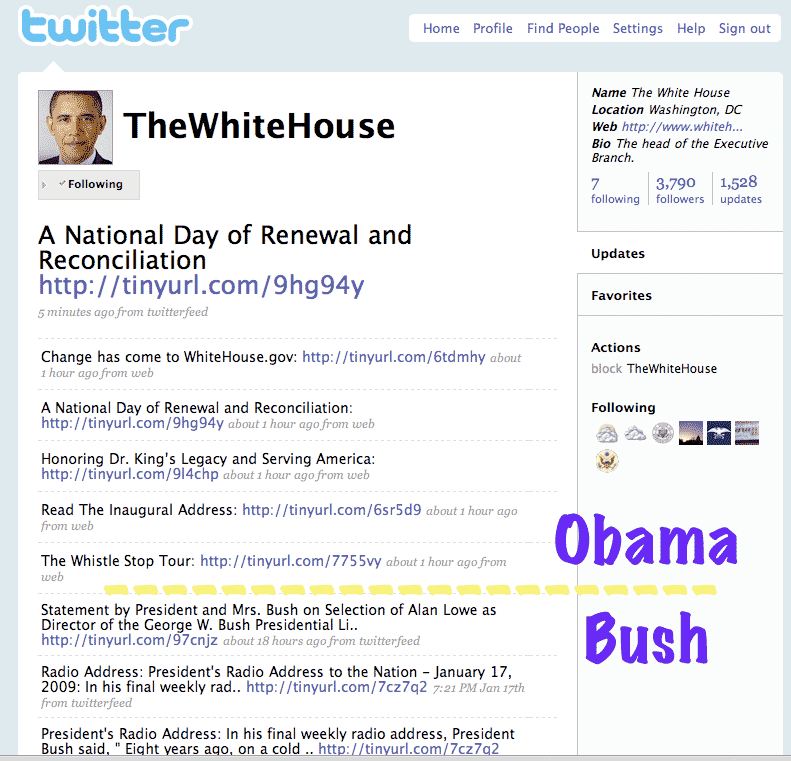
But watching the inauguration of Barack Obama on CNNHD, even with my laptop by my side, I can see that TV gives a different and somehow communal experience of news events, quite unlike the hunt-and-peek solipsist patchwork of (for instance) my TV-less website surfing on Election night.
In Wikipedia, there’s a policy we call WEIGHT — basically, an article should represent fairly all competing viewpoints, but without giving such undue weight to unusual views as to imply that these viewpoints are widely supported. In TV, there seems to be a policy that we might call DRAMA — for example, to give enormous over-weight to any person or event that generates exciting footage.
I can’t say I’m sorry to be watching hour after hour of the inauguration of Barack Obama. But I like it that I can keep working as I do so.
The old “Gray Lady” New York Times keeps changing her spots in ways that deliver new value–but without creating new profits to replace what got lost in the transition to Web 2.0. Just for example (reverse chronological order; this is a blog, after all) …
NY Times rolls out the latest in a series of information-busting-out APIs, this one to track individual voting histories in the US Congress. Business model? They’re free.
NY Times partners with Userland to deliver news stories via RSS feeds.
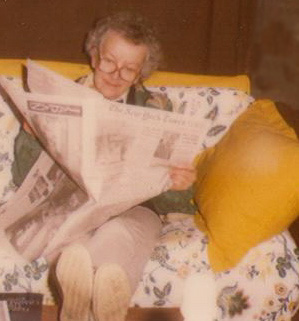
The NY Times is no longer (just) my mom’s messy mass of newsprint (see below, ca 1984.) It did a great job at that, but it is now setting out to do great things in a much, much bigger World 2.0. I just hope Web 2.0 finds ways to support them in turn.
One of my Dortmunder favorites, Don’t Ask, starts with Dortmunder in a traffic-stuck frozen fish truck but lurches him forward into the theft (more than once) of an 800 year-old femur disputed by two angry countries.
More Westlake wonders, all of them suitable to keep you happy on airplanes, even when jostled by turbulent weather or children…
Newswoman Sara Joslyn goes to work at notorious tabloid and runs afoul of murder mystery while working on stories of century-old twins, a star’s honeymoon, and a “body in a box”; romance as a bonus with great police intervention which I’m restraining myself from describing.
Sara Joslyn again, now working for cute boss Jack at a trendy New York magazine called Trend, re-meets some of her tabloid pals in Branson country-western land and gets tangled up in an even more tricky mystery.
Begun in 1986 and/or 1990, according to its preface, this book recounts a struggle carried out by one angel and one demon against God’s plan for the end of the universe. Remarkably similar in its premise to Gaiman and Pratchett’s Good Omens (1990), which I also love, this book takes a different pathway, both darker and funnier, to — but of course I don’t want to spoil the ending.
I am now regretting I never wrote Westlake any fan mail — this blog post must now suffice. He was a true craftsman whose work made the world better, not least by making us laugh.
…The quantum world is a New New World far more alien and difficult of access than Columbus’ Old New World. It is also, in a real sense, much bigger… Our fundamental equations do not live in the three-dimensional space of classical physics, but in an (effectively) infinite-dimensional space: Hilbert space. It will take us much more than a century to homestead that New New World, even at today’s much-accelerated pace…
In the next five years, policy-makers around the world will embrace economic theories (e.g. those of Richard Layard) aimed at creating happiness. The Tower of Economic Babble is rubble. Long live the new, improved happiness economics! …
Here are other short samples from just a few more of the best:
I will see the development of robots that people will want to spend time with. Not just a little time, time in which the robots serve as amusements, but enough time and with enough interactivity that the robots will be experienced as companions, each closer to a someone than a something. I think of this as the robotic moment…
…If there is such a thing as a world mind today, then its thoughts are primarily about commerce. It is the “invisible hand” of Adam Smith, deciding the prices, allocating the capital…I call this the hindbrain because it is performing unconscious functions necessary to the organism’s own survival, functions that are so primitive that they predate development of the brain. Included in this hindbrain are the functions of preference and attention that create celebrity, popularity and fashion, all fundamental to the operation of human society. This hindbrain is ancient….
…Program the assemblers to put together an SUV, a sailboat, or a spacecraft, and they’d do it—automatically, and without human aid or intervention. Further, they’d do it using cheap, readily-available feedstock molecules as raw materials. The idea sounds fatuous in the extreme…until you remember that objects as big and complex as whales, dinosaurs, and sumo wrestlers got built in a moderately analogous fashion…
…the thing that we think of as “us”,can become separated from our body, or nearly separated anyway. I don’t suggest we will be able to transplant our mind to another body, but we will be able to introduce new body parts into existing bodies with a resident mind. With enough such replacements, we will become potentially immortal: like ancient buildings that exist only because over the centuries each of their many stones has been replaced…
…There seems to be a Malthusian principle at work: information grows exponentially, but useful information grows only linearly. Noise will drown out signal. The moment that we, as a species, finally have the memory to store our every thought, etch our every experience into a digital medium, it will be hard to avoid slipping into a Borgesian nightmare where we are engulfed by our own mental refuse…
…Having been forced to choose a single game changer, I have turned away from the fascinating scientific developments I might like to see, and will instead focus on the one game changer that I will hopefully never directly witness, but nevertheless expect will occur during my lifetime: the use of nuclear weapons against a civilian population…
I join Lawrence in hoping that his prediction won’t come true.
The civilized veneer of chess is deservedly rrrrrripped away in this fine video, which I found via Improbable.com. I shed some of my bitterest bad-sportsmanship tears over a chess game, and although I was less than ten years old when I shed them, I remember that near-defeat agony clearly today. It was only a near-defeat because my Aunt Harriet unaccountably failed to capture my undefended queen, and instead moved her own queen into a spot where I could take it.
If chess savagery featured on BoingBoing, somebody would be crying out for a unicorn chaser. Would the savage unicorn in this video suffice? It certainly seems to be chasing the other chess pieces.