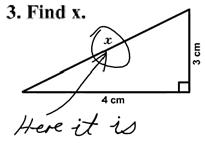
Via The Zen of Motorcycling, this math-challenged student’s solution to the age old problem:

Comments Off on The eternal triangle isn’t what it was….Tags: Learn to write funny
Would you believe, I got called to jury duty on Wednesday morning– talk about an un-American thing to do to a Thanksgiving-cooking mom! So this year we had store-bought pies, though I still home-made killer brownies and biscuit-crust veggies.
More racing around like a maniac in my real life means less time* for writing in my blog (as opposed to Thanksgiving in 2003 and 2004.) But I’m thankful for all the family and food and fun that has swirled through my life in the past 24 hours–and next year, I hope to do it all, all over again.
Except for the part where I burned the microwave popcorn, filling the entire house with stinky smoke. Next year, if I manage not to do that again, I’ll be extra thankful.
* At least I was helping to keep the Web clear for Niek Hockx…
Comments Off on Except for the popcorn going up in smoke…Tags: Wide wonderful world
Monty-Python IM slang from RickLibrarian may soon replace smilies and ROFL–for example:
But why should Python-ites have all the fun? Star Warsians use MTFBWY (“May the Force be with you”), but surely there’s a lot of good stuff still unmined:
I’d also like to nominate:
That’s enough! Signing off now, but you know I’ll return, so SMAKIBBFB.
Thanks to The Shifted Librarian for this link!
p.s. Awesomely, the Acronym Finder does indeed know about MTFBWY and ANFSCD. Did you know that NETSI also stands for New England Tech Stock Index? I wonder if the Python-ians could patent that acronym as prior art and then sue for damages–wow, maybe enough leftover dotcom options to wallpaper a castle…
Thanks to the improbable Marc Abrahams for his find of this acronym finder…
Comments Off on My hovercraft is full of IM shorthandTags: Learn to write funny
Long ago, in a trouble-free galaxy far away where fairies in flannel shirts played Donkey Kong with dinosaurs in Doc Martens, we happily posted our email addresses all over the web.
In today’s world of bots and spammers, the question arises–how can we declare our own ownership of our own web pages, while providing a way for real readers to get in touch.
Dave Winer proposes a simple and standardized way to solve the problem. He’s asking for comments and feedback, so go check it out.
Comments Off on Declaring identity in a world full of spammersTags: Reputation systems
Nigerian spam email. Slashdot trolling. Search engine spam–even ping spam.
Wherever you might expect to find information, spammers will be eager to insert some disinformation.
Consider the various online reputation systems–for example eBay’s feedback system or just about anyone’s list of popular bloggers.
Positive spam attempts to raise reputation scores in some deceptive way–maybe creating a bunch of fake eBay transactions, then giving yourself very positive ratings.
Negative spam has a much higher cost to the commons. Trolls who take pleasure in “gratuitous vituperation, scurrilous disparagement and malignant calumny,” (to quote the online Britannica on defamation) drive productive group members away from the commons.
Comments Off on Reputation spam in two spammy flavorsTags: Reputation systems
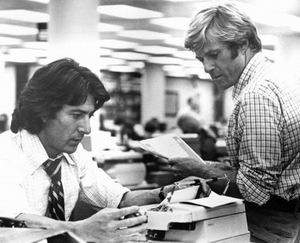 |
Halley’s pithy Comment on Bob “I’m In The Habit Of Keeping Secrets” Woodward:
This reminded me of yet-another great Ira Flatow remark, from across some restaurant table or other in Cleveland:
There was a time when we all, even Robert Redford, wanted to be Bob Woodward*… |
* Once a great investigative reporter, Robert Woodward is now spinning nightly on a TV set near you in his new role as Bush White House stenographer…
Comments Off on We liked Robert Redford’s character so much better…Tags: Editorial
Some quotes that should inspire or constrain us when we try to improve online reputation systems:
Comments Off on Reputation: Inspirations and pitfallsTags: Reputation systems
I was out of town for the Corante Symposium on Social Architecture, but got to hang out at two fine afterparties, the first hosted by Charlie Nesson and the second one BlogHer-centric but gender-mixed.
It was great to meet (finally!) BlogHer-oine Lisa Stone and to share lunchtime musings with Liz Lawley. Not enough time to hang out with the hellacious Halley Suitt, or with IdentityWoman Kaliya Hamlin, David IsenbergDavid Isenberg, Phil Wolff, Kevin Marks…
(And curses on the evil forces that kept away conference-attenders David Weinberger or Frank Paynter or Tony Kahn, folks I would have loved to see there.)
Thanks to the tag-errific Mary Hodder for inviting me and to all of you guys for letting me rant about reputation systems.
Comments Off on Social architecture of post-conference partiesTags: Metablogging
Suppose it’s true that mathematically speaking, a trustworthy reputation system is exactly as good as genetic kinship in promoting prosocial behavior by group members.
Boiling that down into an online model, reputation systems are critical to social software, which depend on their users behaving in positive ways.
The motivation of A to add value to an online commons depends critically on A’s belief that good users are labeled as good and bad users as bad.*
It also follows that any social software can benefit simply by publicizing its reputation system.
The fact that eBay’s reputation system is digital and public while wikipedia’s reputation system is complex and unevenly enforced may account for the more frequent trollish disruptions at wikipedia.* *
A portable online reputation system could be somewhat like the “online citizenship” model proposed by
Ken Jordan, Jan Hauser, and Steven Foster, and expanded at today’s Symposium on Social Architecture by Kaliya Hamlin. I look forward to re-seeing Kaliya tonight, to ask her about it.
* Your public reputation score doesn’t have to jeopardize your right to privacy for personal data like real names, etc.
* * The reputation systems used by eBay, wikipedia, Amazon, SlashDot, etc. are very different. (So are the kinds of behavior each hopes to promote.) The type of reputation system doesn’t matter, however–just its accuracy, as perceived by users. The only detail of desired behavior that matters is its cost-to-benefit ratio.
Technorati Tags: corantessa
Comments Off on Reputation systems in social softwareTags: Reputation systems
“I make a point of going to other people’s funerals because otherwise they won’t come to mine.”
Yogi Berra
Mathematical biologist JBS Haldane famously declared that he would lay down his life for two brothers or eight cousins. Craigslist and Flickr are two of my favorite reminders that lots of webfolk imitate Yogi Berra instead of Haldane.
I’ve been reading a fascinating article in Nature*, “Evolution of indirect reciprocity.” It gives mathematical models where reputation systems provide a very good substitute for genetic kinship. That is, it benefits me to behave altruistically toward someone who’s adding value to the commons, even if I don’t get my own direct payback from that specific person.
The article is by Martin Nowak, a friend from our Princeton days and Karl Sigmund, whose many benefits to our common commons include feeding 3 year-old Sergei Brin his first guglhupf.
* (Nature 437 , 1291-1298 (27 October 2005)
Comments Off on Two brothers, eight cousins, and CraigslistTags: Reputation systems